
Product Management Already Evolved: You're Just Now Realizing It
You no longer have the product management role you signed up for, and that's actually good news.

I spent my holiday break in the code. Between launching the AI Advent Challenge and participating in the global SheBuilds Lovable’s hackathon, I was not just writing strategy. I was building. I was debugging. I was feeling the friction that happens when you move from a mere “vibe” to a working product.
Here’s what nobody wants to admit: the product manager job description you’re working from right now was written in 2019. Maybe 2020. Definitely not for 2026.
You’ve been trained to write user stories. Manage backlogs. Translate between business and engineering. Sit in meetings. Write PRDs that nobody reads. Get approval from stakeholders who move the goalpost every quarter.
That job? It’s already being automated.
Not next year. Not in 18 months. Right now.
For the past year, we have been suspended in a state of frenetic experimentation. We loved the generative ease of “vibe coding” where the primary metric of success was novelty. But as the holiday momentum settles, a stark reality has emerged. The “toy phase” is over.
The “big thing” we have been waiting for is not a new model release. It is the rigorous and demanding work of integration.
What You’ll Learn
The Post-Hype Reality: Why “vibe coding” without architectural oversight is creating unmaintainable codebases.
Trend #1: The migration from writing User Stories to engineering System Prompts.
Trend #2: The transition from reactive Chatbots to systems where agents actually work together.
Trend #3: The non-negotiable “Builder Requirement” that will define career ceilings in 2026.
The Real Shift Nobody’s Talking About
I noticed a pattern while building the tech stack for the recent challenges. Let me be direct: the role is splitting into two completely different games, and you’re probably still playing the wrong one.
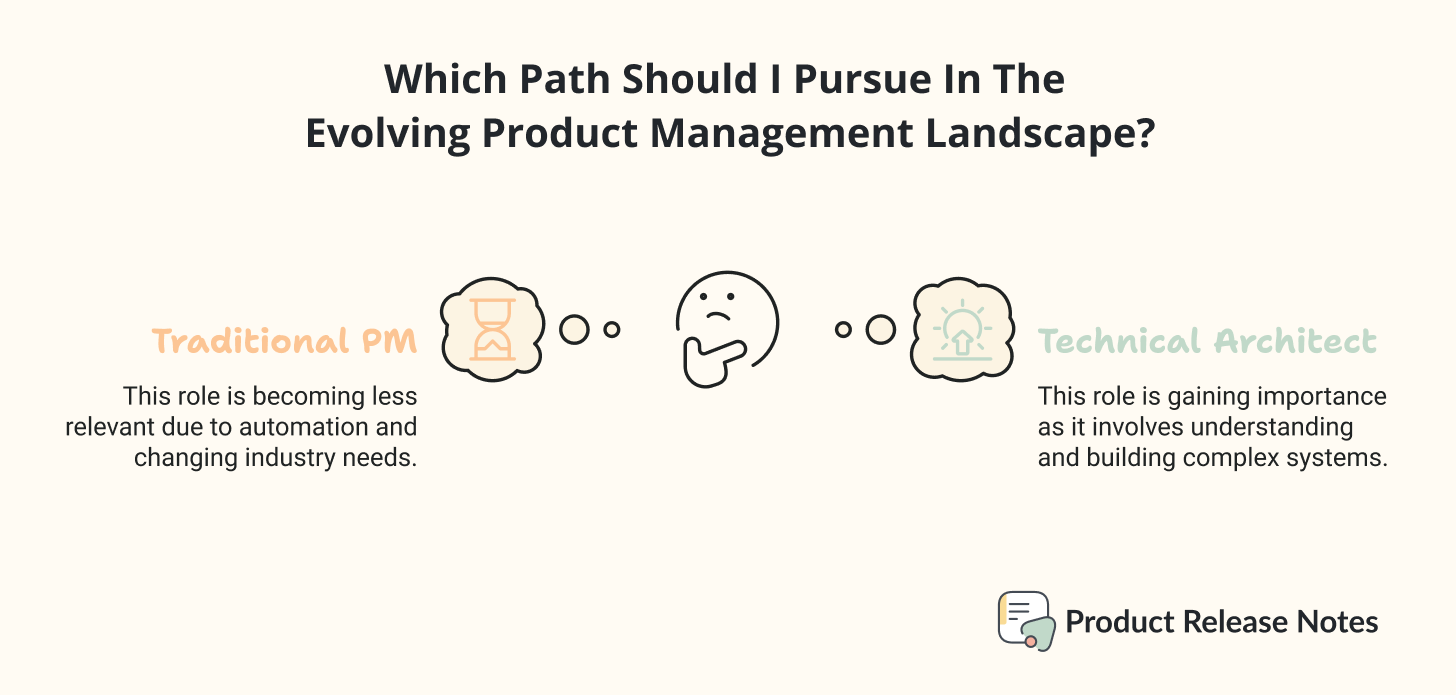
Game 1: The Traditional PM (Shrinking Market)
This is what you’ve been trained to do. Write requirements. Manage timelines. Coordinate between teams. Get buy-in from stakeholders. Create the Jira tickets. Attend the meetings.
The role of the Generalist PM, the facilitator who manages backlogs and translates requirements, is facing an extinction event. If this is your entire skill set in 2026, you’re seeing the first signals. Your influence is shrinking. Engineering teams are shipping faster without you. Stakeholders are building prototypes themselves. You’re being asked to do more with less, but nobody explained that “less” includes less of your actual job.
The problem isn’t you. The problem is the job description was designed for a world where you were the fastest way to turn ideas into technical plans. You’re not anymore.
Game 2: The Technical Architect (Expanding Opportunity)
In its place, a new archetype is ascending: the Technical Product Architect. This is what’s actually valuable now. Understanding system design. Architecting how AI agents work together. Writing prompts that are precise enough to guide intelligent systems. Building prototypes yourself to validate ideas before handing them to engineering. Orchestrating silicon workforces the same way you once coordinated human teams.
This requires something you probably weren’t taught: you have to understand how systems actually work. Not theoretically. Practically.
The gap between these two roles is the opportunity. Most PMs haven’t made the jump. The ones who have are already pulling away.
P.S. — I’m Teaching at COZORA 🚀
COZORA is a live AI learning community where experts show their screens and walk through how they actually work. Not courses. Not theory. Real workflows from people building right now.
I’m teaching on system prompts and how to architect AI into your product development. My paid subscribers get 50% off.
👉 Join COZORA — 50% off for paid subscribers
The Post-Hype Reality: The Hangover of 2025
Future historians will likely chronicle 2025 as the year of the “Vibe Coding” experiment. It was a period where the promise was simple: if you can speak English, you can be a software engineer. This narrative drove a surge in “wrapper” applications that looked great in a demo but crumbled under production traffic.
The “vibe coding hangover” has now set in. When you treat AI as a magic wand instead of a stochastic component within a well-architected system, it fails you at the first sign of complexity.
Senior engineers are already reporting “development hell” where codebases generated without architectural oversight have become unmaintainable. The “magic” of the LLM has collided with the finite constraints of the compiler and the database.
This is the “Integration Gap.” The problem isn’t the AI itself. It is the lack of architecture. In 2026, your value as a PM is determined by how well you bridge this gap. You’re not waiting for someone else to build the prototype. You’re not just asking for permission to build. You’re demonstrating proof of value. You’re bringing solutions, not just problems.
Trend #1: From User Stories to System Prompts
For nearly two decades, the User Story was our atomic unit of work. We wrote “As a user, I want...” and expected a human engineer to fill in the gaps with intuition and common sense.
Traditional PRDs are dead. Not because nobody reads them. They are dead because AI doesn’t understand them the way humans do.
When your developer is an AI agent or an engineer using AI tools, ambiguity is a vector for hallucination. An LLM does not possess shared context unless you explicitly engineer it into the input. The first pillar of the 2026 Blueprint is the shift from “Intent-Based Specification” to “Constraint-Based Specification.”
We are no longer writing stories for interpretation. We are engineering System Prompts as active components of your codebase.
Anatomy of a Product-Grade System Prompt
A System Prompt is an active component of your codebase. It lives in files like .cursorrules and governs the behavior of the AI agents assisting with the build. You must define the Identity, Context, Logic, and Constraints with surgical precision.
Think of it this way: you’re not writing for a human who will fill in gaps with common sense. You’re writing for an intelligent system that only knows what you tell it. If your documentation isn’t precise enough to be parsed by an LLM, your spec is already obsolete.
The best specs now are structured. Explicit. No room for assumption. They live as “Master Context Files” in your codebase, evolving documents that define your design tokens, business rules, and database schema.
If you can’t explain it clearly enough for a language model to implement it correctly, your spec wasn’t actually clear.
Trend #2: Systems Where Agents Work Together
If 2025 was the year of the Chatbot, 2026 is the year of systems where agents work together to get things done. The distinction is critical. A chatbot is reactive; it waits for you to type. An agent system is proactive; it pursues an outcome.
The unit of value is no longer the response but the result.
To lead in this era, you must stop designing chat interfaces and start architecting how information flows through the system. You’re moving away from linear workflows toward robust, dynamic graphs. In this architecture, you define the specialized agents and the “state,” which is the structured object they pass between them.
While building my latest prototypes, I realized that “State” is the new “Database Schema.” You have to define what the system remembers. You have to architect where the “Human-in-the-Loop” intervention points sit. This isn’t just a technical choice. It is a requirement for responsible building.
A PM who cannot architect these flows is just a passenger in their own product development. A PM who understands state management is the one deciding how multiple agents coordinate to deliver outcomes.
Trend #3: The ‘Builder’ Requirement
Perhaps the most controversial shift is the collapse of the “Idea Guy” PM archetype. For years, it was acceptable for a PM to exist solely as a translator between the business and engineering. That middleman role is being automated.
The barrier to entry for creating functional software has collapsed. With tools like Lovable, Cursor, and Replit, a PM who cannot prototype their own ideas faces a hard career ceiling in 2026.
I am not saying you need a Computer Science degree. I am saying you need “Vibe Coding” literacy. You need to be able to look at a broken prototype and identify why the data isn’t saving. You need to be able to build an MVP to validate an idea before you ever consume expensive engineering resources.
The workflow for 2026 is simple: Ideate, Prototype, Validate, then Handoff to engineering for Hardening. You bring solutions to the table, not just problems.
The teams dominating their markets right now have figured this out. They’re not hiring traditional PMs. Or if they are, they’re retraining them immediately.
What’s Actually Happening at the Companies Moving Fast
The old workflow:
Idea → Spec → Stakeholder approval → Engineering backlog → Development → Demo → Feedback → Iterate
The new workflow:
Idea → Prototype with AI (30 minutes) → User feedback (real users, real behavior) → Hardening in production → Ship
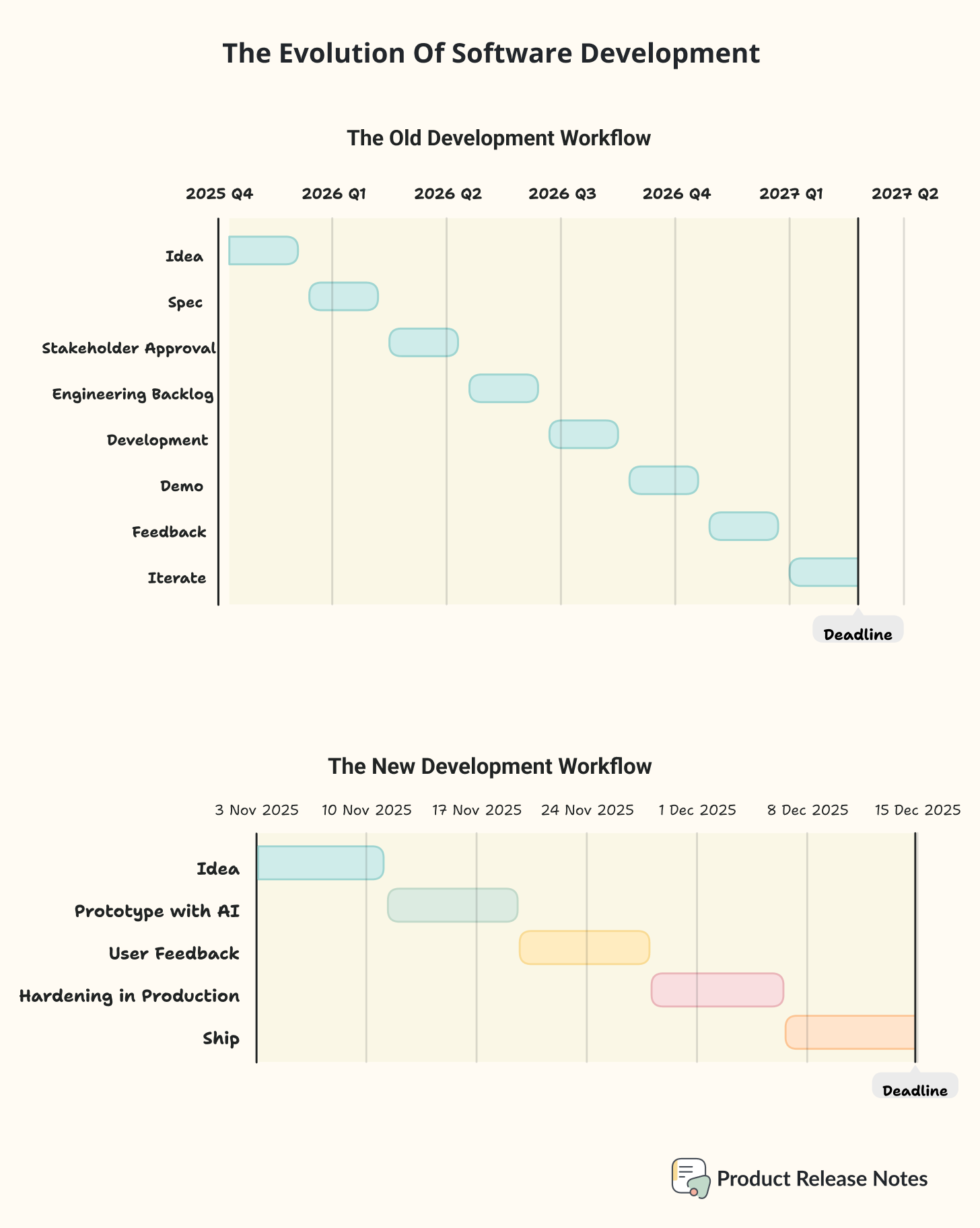
The difference isn’t marginal. It’s a 10x speedup because you’ve eliminated all the translation steps. But here’s the part that matters: that speedup only works if the PM can prototype.
Your First Move (This Week)
This doesn’t require learning to code. This doesn’t require a Computer Science degree or years of ML experience.
It requires one thing: build something.
Pick a small feature you’ve been thinking about. Something you’ve written a spec for or mentioned in a meeting. Go to Lovable, Cursor, or Replit. Spend 30 minutes describing what you want.
You’re not trying to build production code. You’re trying to understand how the tool works and what’s actually possible when you don’t have to ask permission from engineering.
I can assure you 3 things will happen:
1️⃣ First, you’ll realize how much clearer you can think when you’re building rather than writing specs. Ambiguities jump out immediately. You’ll discover requirements you didn’t know you had.
2️⃣ Second, you’ll understand why your engineers have been frustrated with some of your specs. When you’re the one trying to build it, you realize what details you were missing.
3️⃣ Third, you’ll have a prototype in less time than it takes to schedule a standup. Users can play with it. You can see if the idea actually works.
That’s worth more than a 50-page PRD.
Do that once and the whole world looks different.
The 2026 Strategic Roadmap
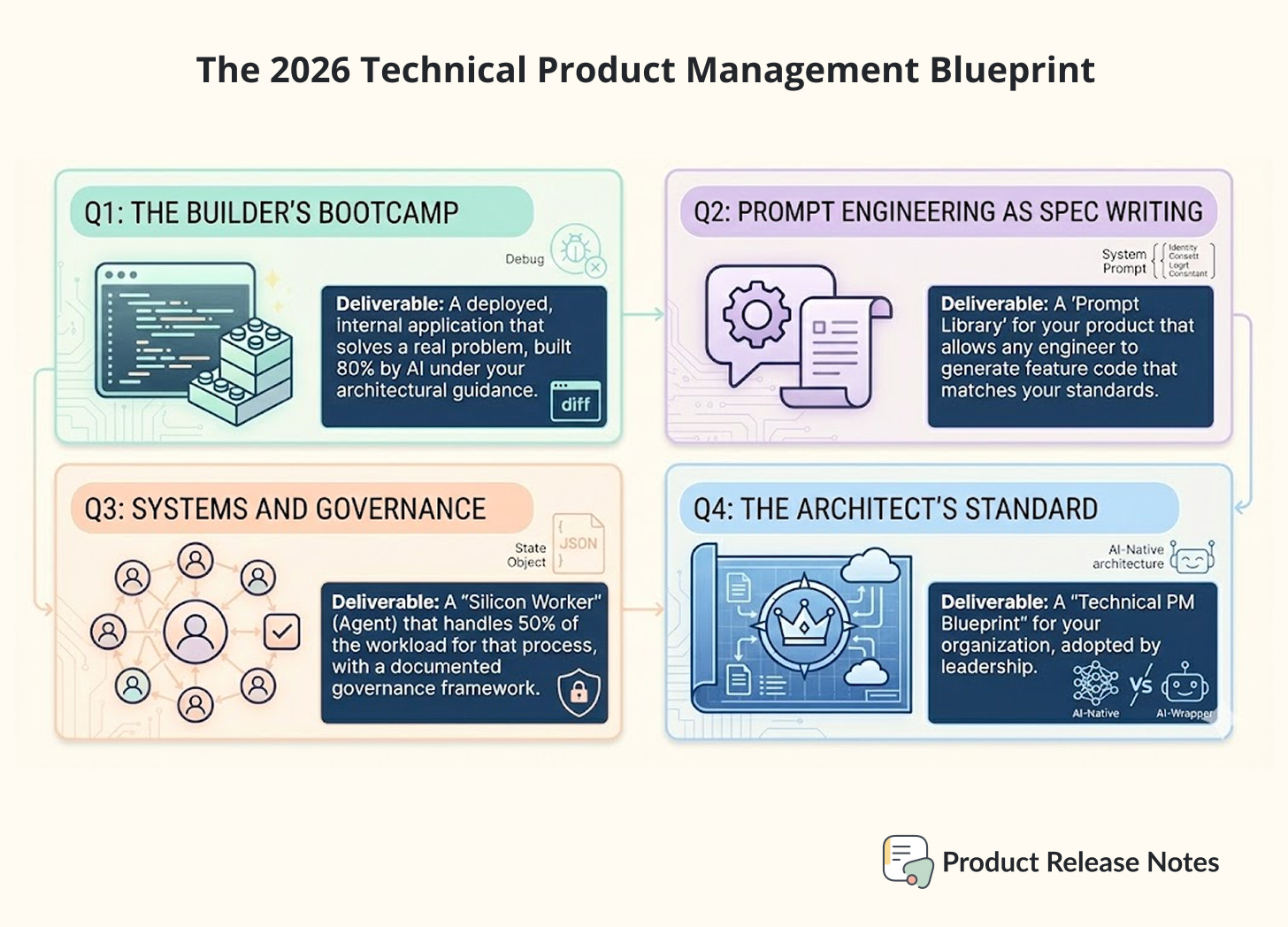
Q1: The Builder’s Bootcamp
Stop writing PRDs for internal tools. Use a tool like Lovable or Cursor to build a functional utility for your team. Learn to debug AI output by reading the changes in the code. Deliverable: A deployed, internal application that solves a real problem, built 80% by AI under your architectural guidance.
Q2: Prompt Engineering as Spec Writing
Rewrite your ambiguous User Stories as structured System Prompts. Create a “Master Context File” for your product that defines its design tokens and business rules. Deliverable: A “Prompt Library” for your product that allows any engineer to generate feature code that matches your standards.
Q3: Systems and Governance
Identify a repetitive process in your organization. Architect a multi-agent workflow to automate it. Define the “State Object” that the agents pass between them. Design the “Human-in-the-Loop” intervention points. Deliverable: A “Silicon Worker” (Agent) that handles 50% of the workload for that process, with a documented governance framework.
Q4: The Architect’s Standard
Update your standards. Use your “Builder” experience to influence the technical roadmap, advocating for AI-Native architecture rather than just AI-Wrapper features. Deliverable: A “Technical PM Blueprint” for your organization, adopted by leadership.
Final Thoughts
The Construction Has Begun
We have definitively exited the “Play Phase.” The Post-Hype Reality has revealed that the true value of this technology lies in the architecture, not the chatbox.
We are witnessing the end of “Managing Products.” We are witnessing the birth of “Building Intelligence.” The tools of creation have been democratized, but the discipline of architecture has never been more elite.
The “what” of 2026 is Agentic AI. The “how” is up to you. You can remain a manager of tickets, or you can become an architect of intelligence. The choice is binary.
In the next few weeks, I am going to be sharing a massive shift in how I am approaching this publication to help you navigate this exact blueprint. We are moving beyond just “Product Management” into the deeper waters of building with logic. Stay tuned for the construction updates. 🚀
What’s your biggest hurdle stopping you from building your first AI prototype this week? Is it specification? Is it timeline? Is it imposter syndrome? Drop it below and let’s figure it out together. 👇
Thank you for the detailed breakdown of how PM roles are changing. And agree that actually building a prototype and playing with it (and breaking it 😆) is a great way to figure out exactly what you do and don’t want in a product.
Yes, to technical architect! I really appreciate you laying out the path as I’ve been transitioning from a technical program manager role, which is also merging with other areas, mostly the old let’s just have the engineers do it.
I’ve learned to leverage prompting within lovable to get the prototype sorted. Having ChatGPT or another LLM finetune your prompt does save on tokens.